Monday, May 23, 2016

100th INDY 500 VIEWING PREPARATION GUIDE

CLICK IMAGES TO VIEW FULL SIZE


Welcome race fans! It's time once again to stock the coffee table with consumables and kick back in front of The Greatest Spectacle In Motorsports. Pepto Bismol optional. Hard to believe we've been doing this since wheels and tires were oval...

It is (painfully) well known that I have little knowledge of open-wheel circle track racing. But that ignorance won't keep me from celebrating the 100th Indianapolis 500 on May 29th. Besides, since when has a little detail like total ignorance kept me from telling a story in absolute terms? I rest my case.

Indy cars have fascinated me since early childhood. Before I became aware of Indy's deliciously rich history, I was just drawn to the cool factor: The cast aluminum and magnesium, the injector stacks, the whine of the quickchange and the shriek of the redline hypnotized me. The hardware was enticingly different than the dragsters I drooled on, yet still familiar enough. I soon realized the root attraction was that of any single seat race car: A hot rod stripped down to its essence. Beautiful simplicity.

The first few 500s I followed were on the radio. It was quite the novelty to see my dad so turned on and focused. He was still deep into the Harley Davidson thing then, but would later acquiesce to my brother Rocky's influence and become a hot rodder himself - perhaps in part, due to digging on the Indy 500. The old man and I never did learn to get along, so those memories of hunching over the radio together really light up my rearview mirror.

Chances are, just about everyone has had an equally personal experience around this event. I haven't spoken with everyone on Earth yet, but those I have questioned all had Indy stories - and most were much more interactive than pressing their ear to a radio speaker. I think what sets Indy apart from other motorsports events is the majesty of it. I mean, as dramatic as they are, you can't begin to really experience a drag race or landspeed event via television, but just listening to the Indy 500 on the radio makes your feet vibrate with the power of the pack passing by - you feel like you're right there. That's some pretty potent majesty. Respect! And Happy Anniversary, Indy! May you enjoy many more.


So, blissfully free of actual knowledge, I set out to become an Indy expert in half an hour. Expert enough to salute the singular 100th running, anyway. Racing the clock was fun, but the real pleasure was accumulating sufficient background data for you you to be an informed viewer on race day. You're welcome. I found some interesting (but uncredited) photos online, as well as enough historical headlines to make me dangerous. Here's an example: Louis Meyer (above) took the 1933 checkers. Development of the Meyer/Drake/Offy engine program was just coming to fruition. It soon became a longstanding monopoly. 25 minutes to go.

Photographed from nearly the same spot on the track as the above shot, this current entry illustrates Indy Car evolution since 1933. Photography has also evolved in that time. 24 minutes left.

The Honda aero package appeared very Star Wars when unveiled in 2015. Now it's yesterday's news. Progress has never progressed so fast. 23.5 minutes remaining.


Why all of those spoilers, wings, canards and foils are important. 22 minutes from deadline.


Of course, there will be times when all the aero management on Earth won't keep you on Earth. 20 minutes of research left.

The invention of the pace car was manna for Detroit. Indy and Dirty D have been holding hands ever since. The 2016 Camaro somehow superseded the Corvette for Indy's 100th anniversary. We may never know the true impetus for that decision. 18 minutes from takeoff (took a couple minutes to find the pace car photos).

Gotta keep some spare pace cars on hand, in case a few dozen of them get totaled in a freak accident. Pace cars are very good business. Only 17 minutes left, but at this pace (punny), I'll ace this test!

The justification for 24 extra pace cars. Indianapolis car dealer Eldon Palmer lost control of this Challenger pace car at the start of the '71 race with track owner Tony Hullman riding shotgun. Astronaut John Glenn and NBC Sports announcer Chris Schenkle were in the back seat. Palmer entered pit road at full song and power-slid into the photographer's stand at the end of the line (at 125 MPH). Dozens were hurt, but miraculously, there were no fatalities. 3 minutes remaining - I got hung up reading about this incident. 

And they're off! This image is purportedly the start of the inaugural 1911 Memorial Day Classic. The two-man teams (driver and mechanic) had no choice but to become dust devils for the day. But the dry stuff  washes right down with a bottle of chilled milk. Damn! Missed the checkers by 5 minutes (had to pee)! But now I'm an Indy expert, so you don't have to be.


I've only visited Indianapolis twice: Once at the drag strip (Indianapolis Raceway Park), and once to play at Indianapolis Motor Speedway's infield music festival during qualifying  for the 500 (represented by above photo). Both adventures were life-changers. On our day off at the speedway, I got to spend a few hours in Gasoline Alley with some Pontiac engineers sorting out the new Fiero pace cars. For the rest of the day, I was stationed at the end of pit road, watching cars approach turn one at over 200 MPH, then hanging a hard left, right in front of me. Missed the race though.

                                                                                       *

Okay, you deserve better than a know-nothing wise ass tour guide, so we brought in an actual attendee of the Indy 500 to take over. SGE Rocky Mountain correspondent Pete Garramone (see interview two weeks ago) and his buddies road tripped to Indy in 1956 and Pete took photos. Now we're getting somewhere! You are now the narrator, Pete...


"I remember borrowing an Argus C-3 to shoot these photos.We sat on the backstretch of the infield and had breakfast, sitting between our two cars." Dig their brand new '56 convertible. 

"'The greatest spectacle in sports' was right, back then. I had never seen so many people at one event in my young life. There were probably as many people who didn't get in to see the race as there were inside."

"I think that's Bob Sweikert in the yellow car (might be Sam Hanks), and maybe Dick Rathman behind him."

"A newspaper was printed while the race was going on." (Photos courtesy Pete Garramone)

Thanks Pete!


                                                                                 *


SQUIRREL AND TOOLBOX

If all of this roundy-round talk is driving you nuts, you're not alone. Where's that drag strip exit? 

You know you've arrived, when you can actually drive your toolbox around the pits. If you don't have one of these, you're nobody, pal. IndyCar wrenches know how to live well. 


GRIN

Not really my family, but it sure could be. I swiped this image off of the Bing photo site. Will put it back, after you read this post.

 I went a little nuts on the history of Long Island New York's Vanderbilt Cup races (run from 1904 to 1968) in my introduction to the New York National Speedway feature in the Lost Drag Strips II book. These incredible 'over hill and dale' events drew racers from around the globe, which drew massive crowds, which drew the media, which drew event promoters, which drew flies.

By 1907, the burgeoning motorsports phenomenon had already become a global game of one-upsmanship. European enthusiasts trumped the American Vanderbilt Cup races with the Peking-to-Paris run. Forty international entries hightailed it (for about one day), before bogging down in the undeveloped backlands of what we now call Beijing. Cars were pulled through muck with ropes (above), fell over cliffs, and were swallowed by quicksand. With no gasoline for hundreds of miles, teams made do by burning benzine (it burned, but so poorly that pedestrians were passing the cars). The event took months to conclude, but the survivors remain the definition of hot rod badasses.

In an effort to hold fans' attention after the marathon Peking-to-Paris debacle, the relatively short New York-to-Paris race was presented in 1908. The route was devised to take contestants from New York City to Alaska, then cross into Eastern Europe. But impassable cold forced the pack back down to Seattle to catch a freighter to Yokohama, instead. From Japan, they raced to Siberia (mostly on railroad tracks), where American George Schuster finally crossed the line first on the 4th of July in a Thomas Flyer. Don't know who the "Roberts" is in this photo.

All of that, to illustrate the magnitude of Indianapolis Motor Speedway's achievement. The above events were epic beyond comprehension, but were never repeated. Hundreds of other races worldwide have been declared classics. But from the inaugural green flag on May 30th of 1911, the Indy 500 has been considered the best. Period. For a hundred years now. It is very doubtful that any other racetrack or event will ever break that record. Whether you're front-row-center at the speedway, splayed on the couch in your unmentionables, or strapped into your race car: Happy viewing!


                                         *


Monday, May 16, 2016

DEPTH PERCEPTION TEST

CLICK IMAGES TO VIEW FULL SIZE


To counter last week's image of a two-year-old Scotty attempting to comprehend dirt clods, Motormouth Ray raises the bar with this shot of a two-year-old Ray driving a tin woodie while rocking a sport jacket. I can't compete with that. Ray wins again. (Photo courtesy Motormouth Ray)


We opened up a can of stink last week. A stick was poked at hot rodding's dark (and oh so sensitive) underbelly, and the kneejerk reaction was predictably immediate and passionate, though the tone of said reaction caught us completely off guard. On last week's soapbox, I had asked why so many of us still cling to the seduction of speed and chrome that first drew us in as mouth-breathing testosterone carriers. With age, we've all learned the hard way how the hot rod obsession can inflict a chronic pain that ripples out to everyone involved with us. Yet here we are. Still. So, what's the hook that keeps us from moving on? That was the question de jour.

The surprise is how differently readers perceived the piece (probably a surefire sign that I wasn't clear enough in making my point).  And as usual, no one commented in the provided box (the independent spirit of the SGE Nation cannot be boxed!), but I can share some samples of the e-mails, texts, phone calls and Facebook messages received from friends and strangers alike. Each took a different angle than mine, and they all said it better than I could:


Former Popular Hotrodding magazine editor (and my former boss at CarTech Inc), Scott Parkhurst (at left), networking the 2013 SEMA show. Parkhurst works the ego angle here. (Photo courtesy Scott Parkhurst)

"I think it might be a bit too late to do anything about it, for most of us. I mean, we almost took pride in the fact that we were kind of fucked up. Pride in the same way that guys in a band or artists 'know' they're fucked up. Like, 'we'll never be accountants, or (fill in the blank with shitball office position here), and we're totally okay with that.'

The hot rodder thing, to me, has always been about finding a way to express ourselves that would showcase our individuality and talents - and in such a way as to impress others. For me, a lot of it has really been about chasing girls. It still is, to some degree. I wanted to find a means where girls would want to be with me, and guys would want to be me. When I was driving my loud, angry-sounding car, this was finally truth.

Frankly, there were no better mechanics than I was - no better hot rodders in my school. I was the guy. That became my identity, and I wanted to represent myself that way.
I wasn't very impressive, but my car could be.
I wasn't very fast, but in my car, suddenly I was the fastest guy in town.
I wasn't mean at all, but suddenly I was pretty intimidating, with a lopey idle preceding my arrival.
I wasn't good looking enough to get any girl's attention, but when I rolled in somewhere piloting a badass Max Wedge-powered beast that set off car alarms, it was hard not to notice me.

My cars became my mask - a self-created persona that was so much more expressive than I could be on my own. The cure for my social retardation. The tool that made people want to talk to me. The heavy metal icebreaker and pantydropper. I can't sing, I can't dance, I can't hit a ball with a stick. But right now, in this parking lot, I'm the fucking man. I'm the fucking metallic pearl candy polished billet supercharged MAN!!!

Now most of us are old and tired, and we're not the MAN anymore. No one wants to be the asshole ex-quarterback from high school who can't stop talking about the glory days, from back when they were relevant. So we cherish our photos and our trophies, and our club jackets and our World Record certificates, and we reflect on who we used to be. And we dream about making one more run at it - building that one last hot rod that will incorporate all the tricks we've learned over the years. And we'll share these great times with the great friends we've made who deserve to be in that spotlight with us, and we'll make a few more memories to laugh about as we limp off into the sunset.

It's not young punks you see chasing records at Bonneville, is it? It's not 20-year-olds holding up the Ridler. You don't see anyone under 30 getting their names engraved on the AMBR. That space is reserved for the guys who want to wear that mask one more time - to be the badass they've always been, but life forces them to put that persona away and keep it locked in the toolbox. They represent the thousands of us who just dream about it and wish we could be out there on the salt, or up there on the stage gathering up the awards, or having our name whittled into that big trophy. But for whatever reason, we're not. Or at least, we're not there... yet..."


While Parkhurst still wields enough horsepower to activate estrogen flow, it was the common denominator of letters that led him into the path of author Maggie Stiefvater. I was previously unfamiliar with Stiefvater, but am glad I followed Parkhurst's advice to her latest post on Jalopnik.com. Maggie riffs succinct here on adopting persona.  (Photo courtesy Maggie Stiefvater)

"Earlier this year, I was eating dinner beside a guy who worked for a major luxury car maker. When he heard I had an Evo, he immediately pulled out his phone to show me photos of his own. It was nothing like the elegant poised powerhouses his employer produced. It was petulant and compact, a car spoiling for a bar fight. He had made only minor modifications to it, but they were cohesive. Tastefully done, and I told him so.

He confided, 'This car is what I look like on the inside.'

He didn't have to say it. That was the whole point."


SGE East Coast correspondent Motormouth Ray weighs in on the pros of solace, the cons of mortality, and the priceless conversations with his wrenches. Juxtaposing Parkhurst's salute to vintage badasses, Ray offers an encouraging nod to the next generation of rodders. (Photo courtesy Motormouth Ray)

"I've often found the process of fabricating and building much more enjoyable than the finished product - probably because nothing is ever really finished, in my mind - but more importantly, because I fear that I agree with your theory that hiding under a hood becomes solace. Let's face it: For the most part, people suck. And my wrenches always listen to me and never talk back (mostly).

If I were a bona fide panel beater or brush bender, I'd find solace doing that all day, but I'm not. I'm much more a utility man who enjoys jumping from one thing to another, constantly testing the waters to see if I can add another trick to my bag. Alone!

In writing this, I realize where my 'hook' lies lately: It's when I work with someone younger who not only wants to learn, but has good ideas to share 'upward'. For me, completing the cycle of life is so important, but it happens so rarely that it scares me. I think of all the old men I knew, and wonder how much more information they had to share with me, if only I had asked. Those lost opportunities really suck!

That said, I think we all have to find a path that allows us to connect the dots of our lives, affect people in a positive way, and grow in the process."


Steve Wright and his faithful sidekick, running errands. We met when I did a magazine feature on Steve's '40 Stude gasser-with-a-history. Wright was the first person to contact me after reading last week's ramblings. It didn't take him all day to make his point. (Photo courtesy Steve Wright)

"I've been trying to get to the bottom of this for fifty years. Bottom line: You were born with it. It's in the blood!"

Thanks Steve. I should have just said that in the first place.

Speaking of Steves, the last word goes to Steve Scott (shown with brother John in 1965 at the Oakland Roadster Show, where Scott's "Uncertain-T" won the sweepstakes trophy). T'was Scott who inspired the sensory deprivation writing experiment detailed last week. (Photo courtesy Steve Scott)

"This (post) is terrible! All the verbose verbiage,,, Did you write it this way because you thought this is how you're supposed to write? Who are you trying to impress? What happened to your voice? And I didn't tell you to write about hot rod psychology. I just suggested the experiment to get you out of your comfort zone and into the zen, where the good stuff is waiting."

Thanks Steve. Calling bullshit is what friends do. You're absolutely right - I didn't realize it at the time, but I was nervous about the controversial nature of the topic, and left my voice in my other pants. Busted. Another lesson learned.

And thanks to all who participated in this little "rap session" (I think that's what the kids are calling conversations nowadays). There was no debating nor agenda schlepping. Just some greasy hot rodders sharing experiences in hopes of finding what really makes them tick. So they can keep rolling.


                                                                                  *


UPDATES

For those with actual lives who may not be binging along, here's the latest from Marty Strode's Little Shop of Hors D'oeuvres, just outside of Portland, Oregon.

This week's photos actually come from "Little Bastard" Jim Lindsay's Shedd, Oregon shop. Yes, Marty Strode makes house calls - for a price. A price that Jim Lindsay will surely pay until his final breath.

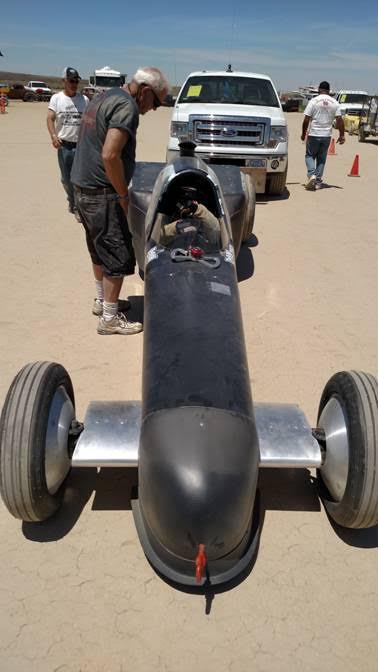
Strode hand-fits the axle fairings to Lindsay's blown gas flathead Modified Roadster, in preparation for some dust storming at El Mirage dry lake. Note inner Moon discs for bonus aero.

Not one to bypass a promotion opportunity, Lindsay's crew applies a wrap depicting the Little Bastards book cover art. 

The graphics may not be visible through the dense dust at El Mirage, but Lindsay will know they are there. Could this added mojo propel the old Model T to a new personal best? Only one way to find out.

It took some doing to cram Lindsay into the cockpit and strap him in...

... but Lindsay eventually settled in and made a 151 MPH check-out pass (in 3rd gear, due to clutch issues). The following day, Lindsay pounded the dirt with a 160 MPH pass, despite continued shifting problems. So the graphics worked. Upon getting the news, builder Marty Strode was stoked: "Let's hope Speedweek at Wendover is possible this August. I'd like to see how that flathead runs on a 3-mile course, versus the 1 1/3 mile at El Mirage." (Photos courtesy Larry Lord)

Unbeknownst to Jim Lindsay, SGE dispatched a pair of undercover observers to El Mirage, "just in case". L-R: Paul "P-Dub" Warner (perhaps America's most savvy engine builder/tuner) and Paul "House" Gilbert (perhaps America's most savvy chassis fabricator/tinman). We flew them down in the corporate jet (okay, a theft-recovery crop duster we found on Craigslist). They should be back in a few days with a full report. (Photo courtesy P-Dub)

                                                                                 *


With Lindsay's speed-reading billboard in California, Strode returned home and resumed work on Pat Ganahl's Spalding Bros. Special tribute. Above is the original. (Photo courtesy Pat Ganahl collection)

Where we left off last time with the T: All mocked-up with nowhere to go but forward.

The roadmap for the build.

The Spalding Bros. made their name with hot ignitions, but were well respected for clean and mean fab work, like this Schroeder steering install. Strode's job last week was to replicate it, employing the same materials and techniques, fifty years after the fact.


There are any number of ways to approach this project, but Ganahl is a stickler for historical accuracy. So Strode followed the clues in the guide photos and proceeded as if he were another Spalding Brother. Here's how it played out, if you'd care to follow along...


Ta da! Looks legit, and should function flawlessly. 

Home sweet home. Center-steer race cars are fun to drive! At press time, Strode and Ganahl were discussing the yays and nays of frame-rail boxing, as it applies to this particular car. No decision has been made as of post time.

Probably not as fast as his Modified Roadster, Lindsay's crate car goes on the back burner, for now. (Photos courtesy Marty Strode)


                                                                                    *

SQUIRREL AND TOOLBOX

I was raised by squirrels. They did the best they could. Now Steve Scott thinks I should write a book about the experience. Alas, ninety-three percent of squirrels are illiterate, and only seven percent of current book buyers know what a squirrel is. The market just isn't there. 


This wooden box likely helped countless projects come to fruition, then was abandoned and fated to become digital photo stock fodder. Did the owner progress from this "Boy Sized" set to a full-scale rollaway? Or did he or she just decide to walk away from all things boy-sized and become adults?


GRIN


If we've learned anything from the last two posts, it's that our perception is informed by our experience. Or, our perceived experience, anyway (it's too easy to bullshit ourselves)...  Of course, real experience doesn't come from a blog. We have to get out of the house and get our hands into something to find usable experience. (And yeah, I've gotten a lot of mileage out of this photo. I'll toss it when it quits working for me)

                                                                                   *


Monday, May 9, 2016

DIG THIS OR NOT

CLICK IMAGES TO VIEW FULL SIZE


In 1958, two-year-old Scotty Gosson had no concern for what may lurk around the next corner. He had his hands full with the down-and-dirty realities of the moment. Already a lone wolf, Gosson went on to become a full-blown isolationist. Considering the kindred spirits gathered around him, this may seem odd. It is not. Featured driveway ornaments at this family gathering include Uncle Walter's Harley, Chevy pickup was Gosson family car de jour, and the Mercury was his Uncle Jim's. (Photo courtesy of Scotty Gosson collection)

You deserve a break. After being force-fed spam and Kool Aid for weeks on this blog, here's the plop-plop-fizz-fizz relief you've earned fairly and squarely with your loyal support. Thank you! Today we abandon all marketing tactics, and offer you a chance to interact with us regarding the real business of life.

Caveat Emptor: The following is merely the opinion of an uneducated bonehead. I may have a different opinion next week. I am not a trained psychologist, nor have I played one on television. My apologies if it comes across as preachy or judgmental. I'm new at this.

Of all people, it was Uncertain T owner/builder/promoter Steve Scott who instigated the experiment. While interviewing Scott for a piece in my America's Wildest Show Rods book in 2013, our windy phone conversations changed direction constantly and strayed to some mutually unexpected places. We soon found that we shared a fascination with the "hook" of hot rodding, and agreed that the attraction was ego-driven, fear-based, and developmentally crippling. That's how it played out for Steve Scott and I, anyway. It just took us a few decades to realize it. Ever since that interview, Scott has insisted that I abandon my fluff-based writings to explore the psycho-emotional framework of hot rodding. My resistance to the suggestion was quite telling. To write out loud of such taboo territory seemed almost an act of betrayal to my readers and heroes. Scott ricocheted that silence would be a disservice to my peers, which gave me pause. I chewed on the challenge for three years.

These discussions continue today, but the only palpable action taken so far has been a primal scream-like exercise in free-form improvisational typing, with eyes closed and ears plugged (at Scott's urging). Besides the inevitable hieroglyphic dyslexia, the result also revealed a surprising tone of judgement, where assessment was called for. I was stunned. I recognized the finger-wagging as the same I've directed at myself for 59 years, but didn't realize I'd been flinging it around. This is when I realized that Scott was on to something important here, and I had some digging to do.

A few pages of  memoirs have been added since, but it's been a painful struggle. Autobiography does not come easy to me. I love to write about you, but telling my own story feels more megalomania than contributory, or even cathartic. I remain conflicted. Below is what was produced during the experiment, edited for lucidity:

TROUBLESHOOTING THE NORTH AMERICAN HOT RODDER

A CASE STUDY

Kicked out of vacuous black holes by God’s own throttle stomp, they blasted straight into our culture with high-beams blazing and wagging tails afire. And the cosmos shook with the rhythm of life itself, while backing a snake charmer melody played on the straight pipes of these mechanized minstrels. Yet I heard not a note. For I am deaf. Dumb. And blind.


Melodramatic, sure. But would you have read further if I had just told the truth? That I was a scared little twerp, trapped in a state of perpetual inadequacy, and painfully oblivious of my potential? That I sought refuge from my fears under the hoods of countless jalopies on the edge of every town I hid out in? Who wants to hear about that? No one who came to the party in search of sparkling dinner conversation, that’s for sure.

So I kept my fear tucked under my hat for twenty eight years, and did the same with my joy for another twenty nine, once I discovered it. Fifty-nine years seems a bit long to keep a secret, or a hat. So today I doff the chapeau and reveal all.

As a grunt soldier in the fabrication army, I’ve been blessedly honored to have connected with many talented and inspiring people. And from the beginnings of my career, I've felt unworthy to hang with most of them. Unqualified to consider myself a contemporary, I look up to them. Early on, I began referring to myself as the Barney Fife (and later, Forrest Gump) of hot rodding. There’s a lot of truth to those titles, no matter how you perceive them. This is (some of) my baggage.

As the friendships with my fabrication heroes piled up and I got to know them, some intriguing personal quirks began to reveal themselves. I began to see in these students of creative craft an obsession bordering on outright terror of any distraction from their narrow focus. Some had interests and hobbies outside of hot rodding, but kept their blinders on tight, regarding social and interpersonal awareness. They just didn’t want to know about it. What I had long perceived as admirable determination and dedication now appeared depressingly dysfunctional to me. I was disappointed - in them (for not meeting my unrealistic expectations), and myself (for being a card-carrying herd member). 

My idols, who had studied under the great masters and became such themselves, now express little interest in their teachers as individuals, or in people in general. In addition, their perceptions of basic sociology seem dated by several decades. This initial eyebrow raiser prompts the base question: Why are we such stalwart hot rodders? What's the real hook?

Okay, that was then. It was an experiment. Today, in the year 2016, I finally pose the question to you, the SGE Nation: Does such a hypotheses warrant investigation? And if so, would anyone care to explore the findings? After all, taken at face value, hot rodding is absolute romance. But get some perspective, and the shine fades - or glows, depending on our willingness to come to terms with the reality under the hood. The apparent bottom line is an ingrained belief that nuts and bolts are more relative, trustworthy, and predictable (and therefore, safer) than human beings. Duh. That red flag stench can't be buried very far under the surface. Where's my shovel?

Can you dig it? Or did I just drop a turd into your punch bowl? I know you'll answer with the number of hits on this post, but, as always, I encourage you to share your take in the comments box at the bottom of the page. Thanks in advance for your feedback.

Still digging, after all these years. Aware that I'll never get to the bottom, I just savor the process, and trust it to guide me to my intended destination. (Photo courtesy of Mary Wilkins-Kelly)


If you're the coolest guy at any given gathering, it's pretty hard to see anything uncool about it. That was the case for Steve Scott, until viewing hot rodding from the other side of the camera, as a Petersen Publishing Company photojournalist. Through the lens, Scott witnessed the exploitation of countless desperate egos, willing to pay any price for ill-perceived glory. Sad. As seen above, Scott was definitely human himself, but ultimately walked away from the scene. For about fifty years. He's better now. (Photo courtesy Steve Scott collection)

                                                                                  *


SQUIRREL AND TOOLBOX

Feeling trapped in your old perspective? It happens. But freedom is usually waiting right under our noses. Hightail it out of there and climb a tree or something! (Photographer unknown)


Okay, so you're not a tree climber? Spring cleaning is therapeutic. The instant gratification alone is enough to put some cut in your strut, Jackson. Still not motivated? Jeepers, Joe! Just do it for Old Glory! Pitching in and doing your part always feels swell. Keep 'em flying! (Artist name withheld by U.S. Department of Defense)


GRIN

While today's sermon was mostly directed at those who may feel they're too old to change (what a crock), it's the younger readers who can best benefit and carry the message forward. We're guessing both young and old can relate to this helpful visual aid, contributed by SGE Human Services Director Motormouth Ray. (Visual aid courtesy SGE Human Services Director Motormouth Ray)


So, what does it all mean? How the hell should I know? Look, I just risked alienating every hot rodder on Earth (a surefire recipe for career suicide) by starting this conversation. It's up to you to continue it. If you feel the need for a guru, go ask Mr. Natural. Spoiler Alert: He'll tell you, "Don't mean shit!" So you'll have to ask the guy in the mirror. (Image courtesy R. Crumb)

                                                                                        *