CLICK IMAGES TO VIEW FULL SIZE
To counter last week's image of a two-year-old Scotty attempting to comprehend dirt clods, Motormouth Ray raises the bar with this shot of a two-year-old Ray driving a tin woodie while rocking a sport jacket. I can't compete with that. Ray wins again. (Photo courtesy Motormouth Ray)
We opened up a can of stink last week. A stick was poked at hot rodding's dark (and oh so sensitive) underbelly, and the kneejerk reaction was predictably immediate and passionate, though the tone of said reaction caught us completely off guard. On last week's soapbox, I had asked why so many of us still cling to the seduction of speed and chrome that first drew us in as mouth-breathing testosterone carriers. With age, we've all learned the hard way how the hot rod obsession can inflict a chronic pain that ripples out to everyone involved with us. Yet here we are. Still. So, what's the hook that keeps us from moving on? That was the question de jour.
The surprise is how differently readers perceived the piece (probably a surefire sign that I wasn't clear enough in making my point). And as usual, no one commented in the provided box (the independent spirit of the SGE Nation cannot be boxed!), but I can share some samples of the e-mails, texts, phone calls and Facebook messages received from friends and strangers alike. Each took a different angle than mine, and they all said it better than I could:
Former Popular Hotrodding magazine editor (and my former boss at CarTech Inc), Scott Parkhurst (at left), networking the 2013 SEMA show. Parkhurst works the ego angle here. (Photo courtesy Scott Parkhurst)
"I think it might be a bit too late to do anything about it, for most of us. I mean, we almost took pride in the fact that we were kind of fucked up. Pride in the same way that guys in a band or artists 'know' they're fucked up. Like, 'we'll never be accountants, or (fill in the blank with shitball office position here), and we're totally okay with that.'
The hot rodder thing, to me, has always been about finding a way to express ourselves that would showcase our individuality and talents - and in such a way as to impress others. For me, a lot of it has really been about chasing girls. It still is, to some degree. I wanted to find a means where girls would want to be with me, and guys would want to be me. When I was driving my loud, angry-sounding car, this was finally truth.
Frankly, there were no better mechanics than I was - no better hot rodders in my school. I was the guy. That became my identity, and I wanted to represent myself that way.
I wasn't very impressive, but my car could be.
I wasn't very fast, but in my car, suddenly I was the fastest guy in town.
I wasn't mean at all, but suddenly I was pretty intimidating, with a lopey idle preceding my arrival.
I wasn't good looking enough to get any girl's attention, but when I rolled in somewhere piloting a badass Max Wedge-powered beast that set off car alarms, it was hard
not to notice me.
My cars became my mask - a self-created persona that was so much more expressive than I could be on my own. The cure for my social retardation. The tool that made people want to talk to me. The heavy metal icebreaker and pantydropper. I can't sing, I can't dance, I can't hit a ball with a stick. But right now, in this parking lot, I'm the fucking man. I'm the fucking metallic pearl candy polished billet supercharged MAN!!!
Now most of us are old and tired, and we're not the MAN anymore. No one wants to be the asshole ex-quarterback from high school who can't stop talking about the glory days, from back when they were relevant. So we cherish our photos and our trophies, and our club jackets and our World Record certificates, and we reflect on who we used to be. And we dream about making one more run at it - building that one last hot rod that will incorporate all the tricks we've learned over the years. And we'll share these great times with the great friends we've made who deserve to be in that spotlight with us, and we'll make a few more memories to laugh about as we limp off into the sunset.
It's not young punks you see chasing records at Bonneville, is it? It's not 20-year-olds holding up the Ridler. You don't see anyone under 30 getting their names engraved on the AMBR. That space is reserved for the guys who want to wear that mask one more time - to be the badass they've always been, but life forces them to put that persona away and keep it locked in the toolbox. They represent the thousands of us who just dream about it and wish we could be out there on the salt, or up there on the stage gathering up the awards, or having our name whittled into that big trophy. But for whatever reason, we're not. Or at least, we're not there... yet..."

While Parkhurst still wields enough horsepower to activate estrogen flow, it was the common denominator of letters that led him into the path of author Maggie Stiefvater. I was previously unfamiliar with Stiefvater, but am glad I followed Parkhurst's advice to her latest post on Jalopnik.com. Maggie riffs succinct here on adopting persona. (Photo courtesy Maggie Stiefvater)
"Earlier this year, I was eating dinner beside a guy who worked for a major luxury car maker. When he heard I had an Evo, he immediately pulled out his phone to show me photos of his own. It was nothing like the elegant poised powerhouses his employer produced. It was petulant and compact, a car spoiling for a bar fight. He had made only minor modifications to it, but they were cohesive. Tastefully done, and I told him so.
He confided, 'This car is what I look like on the inside.'
He didn't have to say it. That was the whole point."
SGE East Coast correspondent Motormouth Ray weighs in on the pros of solace, the cons of mortality, and the priceless conversations with his wrenches. Juxtaposing Parkhurst's salute to vintage badasses, Ray offers an encouraging nod to the next generation of rodders. (Photo courtesy Motormouth Ray)
"I've often found the process of fabricating and building much more enjoyable than the finished product - probably because nothing is ever really finished, in my mind - but more importantly, because I fear that I agree with your theory that hiding under a hood becomes solace. Let's face it: For the most part, people suck. And my wrenches always listen to me and never talk back (mostly).
If I were a bona fide panel beater or brush bender, I'd find solace doing that all day, but I'm not. I'm much more a utility man who enjoys jumping from one thing to another, constantly testing the waters to see if I can add another trick to my bag. Alone!
In writing this, I realize where my 'hook' lies lately: It's when I work with someone younger who not only wants to learn, but has good ideas to share 'upward'. For me, completing the cycle of life is so important, but it happens so rarely that it scares me. I think of all the old men I knew, and wonder how much more information they had to share with me, if only I had asked. Those lost opportunities really suck!
That said, I think we all have to find a path that allows us to connect the dots of our lives, affect people in a positive way, and grow in the process."
Steve Wright and his faithful sidekick, running errands. We met when I did a magazine feature on Steve's '40 Stude gasser-with-a-history. Wright was the first person to contact me after reading last week's ramblings. It didn't take him all day to make his point. (Photo courtesy Steve Wright)
"I've been trying to get to the bottom of this for fifty years. Bottom line: You were born with it. It's in the blood!"
Thanks Steve. I should have just said that in the first place.
Speaking of Steves, the last word goes to Steve Scott (shown with brother John in 1965 at the Oakland Roadster Show, where Scott's "Uncertain-T" won the sweepstakes trophy). T'was Scott who inspired the sensory deprivation writing experiment detailed last week. (Photo courtesy Steve Scott)
"This (post) is terrible! All the verbose verbiage,,, Did you write it this way because you thought this is how you're
supposed to write? Who are you trying to impress? What happened to
your voice? And I didn't tell you to write about hot rod psychology. I just suggested the experiment to get you out of your comfort zone and into the zen, where the good stuff is waiting."
Thanks Steve. Calling bullshit is what friends do. You're absolutely right - I didn't realize it at the time, but I was nervous about the controversial nature of the topic, and left my voice in my other pants. Busted. Another lesson learned.
And thanks to all who participated in this little "rap session" (I think that's what the kids are calling conversations nowadays). There was no debating nor agenda schlepping. Just some greasy hot rodders sharing experiences in hopes of finding what really makes them tick. So they can keep rolling.
*
UPDATES
For those with actual lives who may not be binging along, here's the latest from Marty Strode's Little Shop of Hors D'oeuvres, just outside of Portland, Oregon.
This week's photos actually come from "Little Bastard" Jim Lindsay's Shedd, Oregon shop. Yes, Marty Strode makes house calls - for a price. A price that Jim Lindsay will surely pay until his final breath.
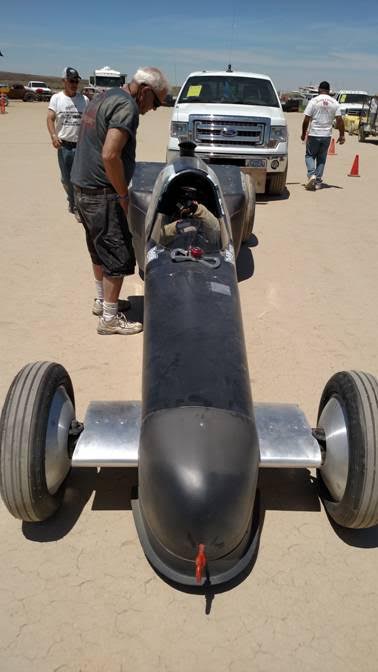
Strode hand-fits the axle fairings to Lindsay's blown gas flathead Modified Roadster, in preparation for some dust storming at El Mirage dry lake. Note inner Moon discs for bonus aero.
Not one to bypass a promotion opportunity, Lindsay's crew applies a wrap depicting the Little Bastards book cover art.
The graphics may not be visible through the dense dust at El Mirage, but Lindsay will know they are there. Could this added mojo propel the old Model T to a new personal best? Only one way to find out.
It took some doing to cram Lindsay into the cockpit and strap him in...
... but Lindsay eventually settled in and made a 151 MPH check-out pass (in 3rd gear, due to clutch issues). The following day, Lindsay pounded the dirt with a 160 MPH pass, despite continued shifting problems. So the graphics worked. Upon getting the news, builder Marty Strode was stoked: "Let's hope Speedweek at Wendover is possible this August. I'd like to see how that flathead runs on a 3-mile course, versus the 1 1/3 mile at El Mirage." (Photos courtesy Larry Lord)
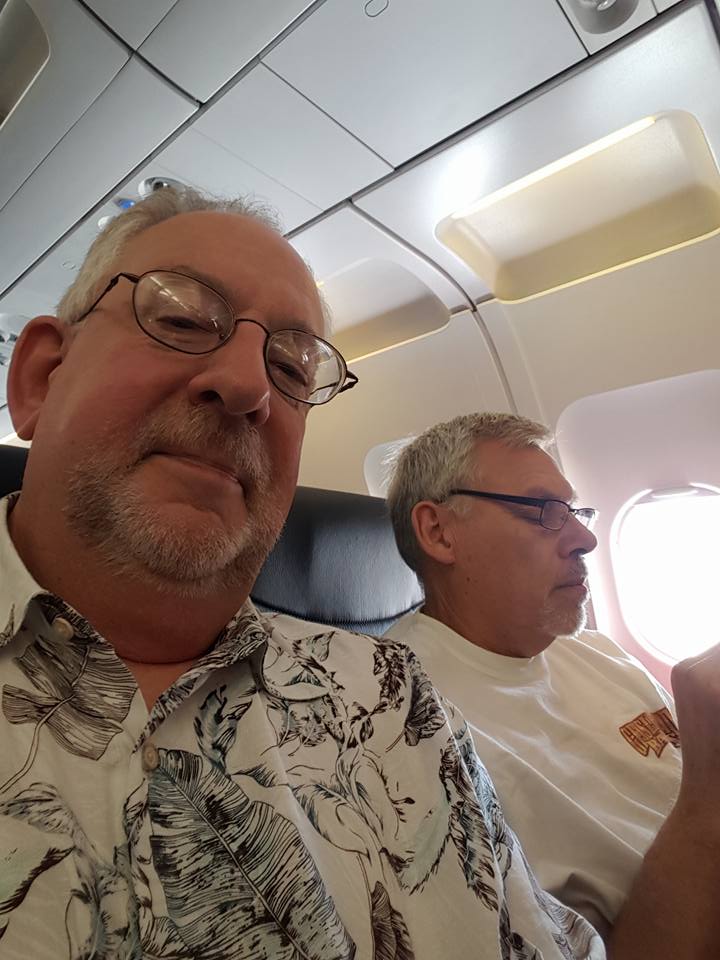
Unbeknownst to Jim Lindsay, SGE dispatched a pair of undercover observers to El Mirage, "just in case". L-R: Paul "P-Dub" Warner (perhaps America's most savvy engine builder/tuner) and Paul "House" Gilbert (perhaps America's most savvy chassis fabricator/tinman). We flew them down in the corporate jet (okay, a theft-recovery crop duster we found on Craigslist). They should be back in a few days with a full report. (Photo courtesy P-Dub)
*
With Lindsay's speed-reading billboard in California, Strode returned home and resumed work on Pat Ganahl's Spalding Bros. Special tribute. Above is the original. (Photo courtesy Pat Ganahl collection)
Where we left off last time with the T: All mocked-up with nowhere to go but forward.
The roadmap for the build.
The Spalding Bros. made their name with hot ignitions, but were well respected for clean and mean fab work, like this Schroeder steering install. Strode's job last week was to replicate it, employing the same materials and techniques, fifty years after the fact.
There are any number of ways to approach this project, but Ganahl is a stickler for historical accuracy. So Strode followed the clues in the guide photos and proceeded as if he were another Spalding Brother. Here's how it played out, if you'd care to follow along...
Ta da! Looks legit, and should function flawlessly.
Home sweet home. Center-steer race cars are fun to drive! At press time, Strode and Ganahl were discussing the yays and nays of frame-rail boxing, as it applies to this particular car. No decision has been made as of post time.
Probably not as fast as his Modified Roadster, Lindsay's crate car goes on the back burner, for now. (Photos courtesy Marty Strode)
*
SQUIRREL AND TOOLBOX
I was raised by squirrels. They did the best they could. Now Steve Scott thinks I should write a book about the experience. Alas, ninety-three percent of squirrels are illiterate, and only seven percent of current book buyers know what a squirrel is. The market just isn't there.
This wooden box likely helped countless projects come to fruition, then was abandoned and fated to become digital photo stock fodder. Did the owner progress from this "Boy Sized" set to a full-scale rollaway? Or did he or she just decide to walk away from all things boy-sized and become adults?
GRIN
If we've learned anything from the last two posts, it's that our perception is informed by our experience. Or, our perceived
experience, anyway (it's too easy to bullshit ourselves)... Of course, real experience doesn't come from a blog. We have to get out of the house and get our hands into something to find usable experience. (And yeah, I've gotten a lot of mileage out of this photo. I'll toss it when it quits working for me)
*
 Dear Mom and Dad: Sixty years of reading this stuff hasn't hurt me one bit. It has actually served me well. To celebrate, Doctor Lockjaw and I assembled this collection for a group photo, shot on the Custom Metal shop floor. This image was intended for a CarTech book project with the working title, "Vintage Speed Parts" (for a chapter on media exposure). After nine months of work, my computer ate the whole thing. This photo (and about five others) is all that was left. (Scotty shot)
 (Photo courtesy Chris Casney)


 (Photos courtesy Glenn Hayes)
 (Scotty shots)
 (Photos courtesy Larry Fator)

 (Scotty shots)
 (Photo courtesy Phil Davis)
 (Photos courtesy Steve Wright)
 (Photos courtesy Race Trevino)
 (Scotty shots)
 (Photos courtesy Stratton Photography)
 (Scotty shots)
 (Photographer unknown)
 (Photographer unknown)
 (Photographer unknown)
 (Photographer unknown)
 (Photographer unknown)
 (Dennis Vollmar shot)
 (Photographer unknown)
 (Photographer unknown, but I bet it's a friend of Marky Izardi)
 (Photographer unknown)
 (Photographer unknown)
 (Photographer unknown)
 (Photographer unknown)
 (Photo courtesy Spike Kilmer)
 (Photographer unknown)
 (Photographer unknown)
 (Photographer unknown)
 (Photographer unknown)
 (Photographer unknown)
 (Photographer unknown)
 (Photographer unknown)
 (Photo courtesy 1320 video)
 (Photographer unknown)
 (Photo courtesy Doug Nichol)
 (Photographer unknown)
 (Photographer unknown)
 (Photographer unknown)
 (Photo courtesy Hot Rod Magazine, I think)
 (Photographer unknown)
 (Photographer unknown)
 (Photographer unknown)
 (Photo courtesy Pontiac Jeff)
 (Photo courtesy Motormouth Ray)
 Veteran SGEites will recall our first mention of squirrels (years ago) to illustrate the street racer spirit in us all. We bring the metaphor full circle this week, with actual human-operated squirrels racing humans. Ah, life. You can't make this stuff up. (Photographer unknown)
 Last week's blog hyped the 100th running of the Indy 500. The event did not disappoint, delivering non-stop drama, complete with an incredible surprise ending. The odds were 100-1 against Indy rookie Alexander Rossi. But the 24 year-old came out from Nevada City, California with a rabbit in his hat. Rossi fist-pumps a microsecond after crossing the bricks ahead of everyone who pitted to refuel. Rossi's Honda sputtered along on fumes throughout the white flag lap, but coasted across the finish line first. (Photo courtesy Hot Rod Magazine)
 After being towed into the winners circle, Rossi emerged from the car in a state of shock, exclaiming, "I have no idea how we pulled that out!". But the win didn't surprise Rossi's mother Dawn, who revealed a bit of the logic behind this David Beats Goliath story: "So proud of him. Not because he won, but because of who he is as a person. It never surprises me when he does something like this." (Photographer unknown)