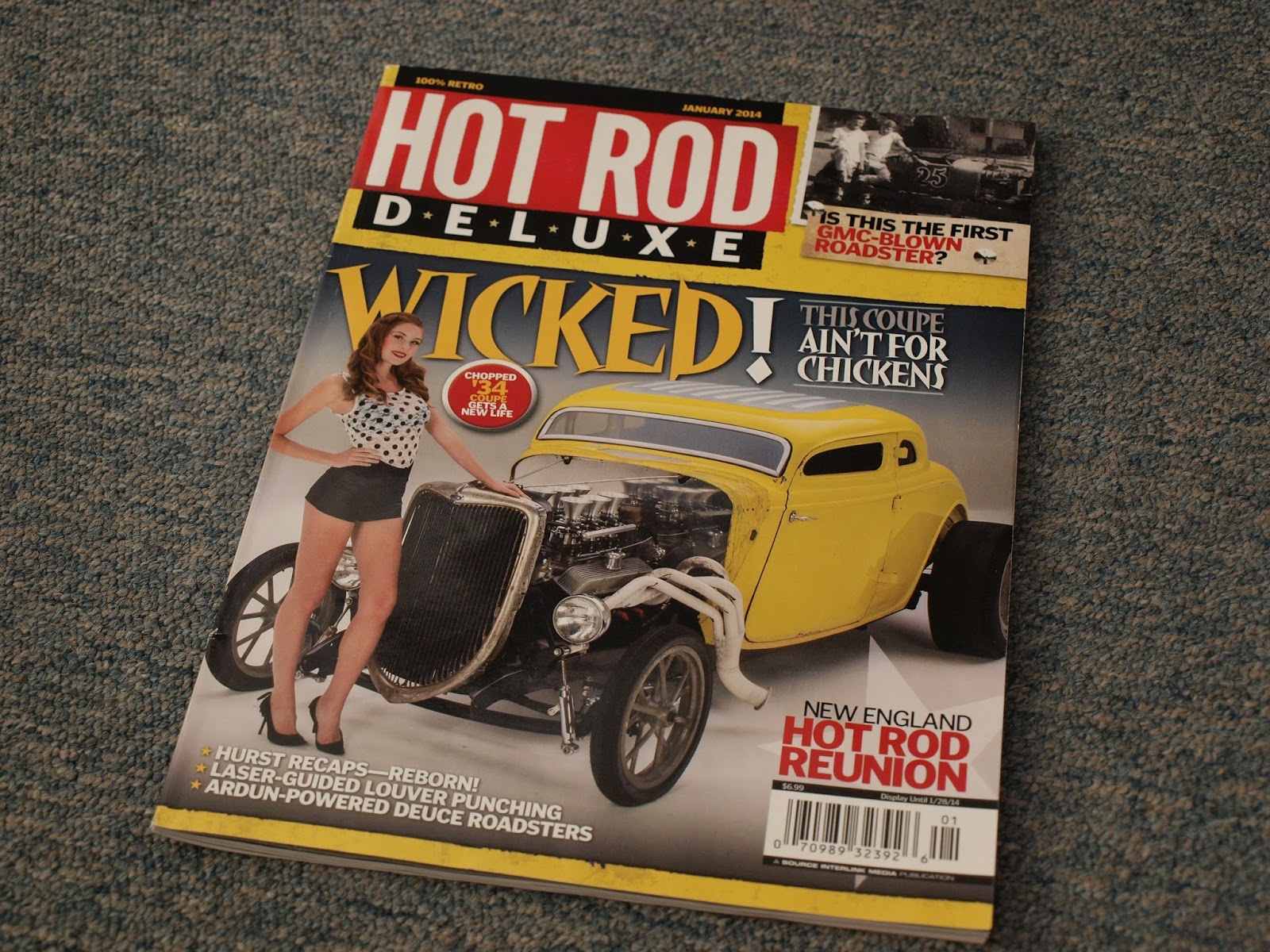
Nuts and bolts tend to accumulate higher word counts than anything else on this blog, but we haven't forgotten that we're also citizens of a larger society. In particular, we wouldn't exist at all without our readership. Our special thanks to each and every one of you! So in the spirit of the holiday season, we present you with a personal Christmas gift this week (and it's perfect for regifting!). Scroll down for a free read of Motormouth Ray's holiday adventure of 1975, certain to become a holiday classic. If you like it, feel free to copy and download it to your personal computer. Ray and I value sharing over profit, and hey, if bootlegging was okay with the Grateful Dead, it's okay by us. This just seemed like a fun way to express our gratitude.
My personal relationship with ink has taken a turn lately. For one thing, despite claims of ultraviolet coatings, I seem to be allergic to the ink on the periodicals I deliver every Friday. It takes me at least 24 hours to shake the flu-like symptoms. For another thing...
Herding words across the page seems an archaic way to communicate in the age of digital awareness. Remember the Y2K scare of 1999? Prince set the stage for the New Millennium, but things didn't turn out quite as expected. I figured by 2010, we'd all be communicating via psychic emotional transfer or something, but here we are at the tail end of 2013 and I'm getting e-mails like this: "gon to reking yrd wut u ned?" and Facebook posts like: "rockin 30 wt at parts store with bff. lol!" We seem to be communicating more than ever and doing a worse job of it than ever. So I press on regardless, hoping for a glimpse of evolution. And I do get glimpses, but ultimately, not much hope.
In fact, I'm alarmed and disappointed daily at my sudden development of judgment. I don't remember aspiring to be judgmental. Life was simple when I was fully accepting. But as I age, it's happening. Snap judgments of car photos have now spilled over to instant pass-or-fail tests of anything and everything I read. It's exhausting. I'm a voracious reader. If it's in front of me, I must read it. Bumper stickers, contents labels, pop-up ads, street signs and fine print disclaimers - nothing is safe from my judging eye. My ego has gone slam out of whack. Mister Wizard, I don't want to be a judge anymore... How are my thoughts on judgement, grammar, the Grateful Dead, Christmas and squids relevant, in a world threatened by robots and zombies? That's a logical question and the answer is quite simple: I haven't given zombies and robots any thought. With that in mind, let's explore the ink that has sustained us over the last week, then we'll unwrap Motormouth Ray's Christmas gift.
*
The biggest news in Scottyville this week is the new (January 2014) issue of Hot Rod Deluxe - the premier edition from new Editor Drew Hardin. I pulled my copy from the mailbox and smiled when I saw the shagnasty '34 coupe on the cover, reassured that our grassroots persona was still intact. All in all, a smooth transition from Dave Wallace Jr. to Drew Hardin, as directed by David Freiburger. Well done, guys! These things aren't always easy to orchestrate, but The Daves ensured Drew was comfy at the butterfly and he kept it in the groove.
The first impression is what counts for a cover car. The story (by Drew) is another classic "long in the tooth street sweeper" tale. My take on a '33 5-window is scheduled for the next issue.
This was special to me. I shot Steve Rutkowski's little digger on the strip (in ten minutes flat), while track manager "G.O." and the Famoso Raceway crew impatiently waited to kick off the 2010 California Hot Rod Reunion. Owner/builder Rutkowski is a great guy and a funster. Our connection was immediate. I'm proud to call him my friend. 50+ years in the making, this was the first anyone had seen of the car and I was beyond honored to share the moment with a hypermanic Rutkowski. The feature was filed away with a "dragsters are a hard sell" caveat, but only three years later, here it is.
Another personal connection. Seven years ago, Marty Strode introduced me to Jack Gillis and I wrote up Jack's story for Northwest Hot Rods magazine, which ultimately produced zero issues. Then the story file was destroyed when my computer kicked out the rods last spring. Marty took it upon himself to tell the story in this issue and now the hot rod family has a new mile marker to refer to. Great job, Marty! Thanks for finally getting my hometown heroes' accomplishments on record. Jack is still kicking, in The Dalles, Oregon.
While touring the Northwest last year, I spent a few chilly and drizzly days jangling with Steve and Cody Adams in their Oregon City shop and snapped some pix of them whipping up a batch of steaming Hurst slicks. That's Dr. Lockjaw's Deuce in the lead shot!
The even bigger and inkier news this week in Scottyville is my late discovery of the writings of Wendell Berry. If you haven't already done so, I urge you to seek out this great American author/poet and digest his essays on our place in the world and our responsibilities to it. Plain spoken and eloquent at once, Berry speaks a direct truth long missing from and vital to our national conversation. Discover it for yourself.
*
LONG STORY SHORT
Though we live on opposite ends of the country (each with their uniquely influential cultures and styles), Motormouth Ray and myself have more in common than not. One challenge we've both encountered is the occasional story that ends up being too long for a magazine piece and too short for a book. We e-mailed examples to each other and were amused to find how similar our dyslexic word count disorders were. I was taken with the universal accessibility of Ray's piece and decided to post it here, lest it rust away to dust in his computer files.
Ray's story turned out to be too lengthy for this blog as well, so I deleted the hilarious extended introduction, detailing the securing of 17-year-old Ray's first full-time job, at a Long Island, New York auto parts store. His new boss (infamous Long Island street racer "Billy Goat") didn't feel that Ray's '65 Cadillac presented the street racer vibe he wanted the store to promote, so said boss generously assisted Ray with the search for a more appropriate vehicle. The setting is Long Island, during the brutal winter of 1975. We join our heroes in the midst of their
third attempt at scoring Ray a solid street racer platform...
... a few days later, Billy Goat told me he had found a deal on not one, but two GTOs. There was a ’67 with a 360 HP YZ-code 400 engine, 4 barrel carb, turbo 400 trans with "His & Hers" shifter, A/C and power windows. The car was black with a white gut and white vinyl top. Classy. In fact, too classy for me. Good thing too, because that’s the one he wanted for himself. The other car was for me: A ’65 with a 335 HP YS-code 389 engine with 4 barrel carb, and the anemic-but-popular two speed automatic. It was a Maifaire Maize (gold) hardtop, with a black gut. Not as classy, but a car I could respect after I took my tool box to it. With true New York style, Billy Goat had worked a deal to get both cars for $225 - his for $150 and mine for $75. Oh yeah, had I mentioned that mine wasn’t running? Here we go guys, the game is about to be on!
The plan was for me to meet up with Billy Goat the following Saturday night at the store, with a car and driver to flat tow the ’65 home with (that’s how we transported cars back then). We’d follow him to the place the cars were at, make the deal, and tow our separate ways. What I didn’t know was that the cars were over an hour away from our Lynbrook location in Middle Island, out in Suffolk County.
In retrospect, we were going to have quite a parade of Pontiacs pounding the pavement that night, and I wish I had a picture of them now. My best friend Tom, my brother Mike and I showed up in Tom’s gold ’68 hidden-headlight Grand Prix to tow the gold ’65 GTO, and Billy Goat was piloting his girlfriend's blue ’74 Grand Prix LJ to tow home the ’67. I realized that night that he had a thing for driving cars that belonged to the females in his life.
We set out for Middle Island about an hour before the sun went down, with the temperature hovering around 25 degrees and the temperament of the night heading in the same downward direction the thermometer was destined to take. When we arrived at the house where the cars were, Billy Goat did all the talking while we surveyed the hardware. The ’67 was a clean, classy driver and the ’65 was - well, let’s just say the ’65 was rough and leave it at that.
The black car looked washed and had a shine, the interior lights came on when the door was opened, the Rallye II wheels reflected an outside garage light nicely, and it even started right up on the first try. The gold beauty had dull paint, no battery, (hence no lights of any kind), and had cheapo black steel rims. And it didn’t run. A push on the top of the rear quarter panel produced less than the desired result, as the car bounced up and down like a pogo stick with a fat man on it. When I asked the owner why this was so, she told me her husband had removed the new Gabriel Hijackers to recoup some of the money he had invested in this piece of crap car he had bought for her. Nice. This was going to be a very different kind of flat tow, indeed.
This might be a good time to clarify the term “flat towing”. If you were truly lucky enough to have access to an American Express or AAA towing service, you never had to worry about how your broken down car would get delivered to a repair shop. If you grew up like I did, making my own way through automotive hell with only the help of a few good friends and whatever courage I could muster, you learned how to flat tow a vehicle. The process is really quite simple and only requires a few key components to work.
You need the following equipment:
A tow vehicle that can adequately pull the weight of the derelict car (with a seasoned driver).
A conduit to affect the tow, such as a rope, chain, or cable; a driver for the derelict car; and of course, the derelict car itself. Note that in some instances, the people used for this process can also be derelicts, but that’s not required. In fact, they should be as lucid and car-savvy as possible (this caveat left out some of my dearest friends).
One last item (that will prove itself later in this ordeal) is that it’s usually best if the tow vehicle and the car it’s pulling are close to the same size. Ideally, the tow car should be the bigger of the two for safe stopping reasons.
To the untrained eye, the flat towing process looks like a very simple procedure, yet it is much more technically complicated than most people believe. If you don’t believe me, just ask any of your friends if they’ve ever flat towed a vehicle, if they were successful at it, and if they’d ever consider doing it again. You’ll get the idea quickly enough how difficult it really is.
There are some misconceptions about the process that I’ll cover right now. First off, it pays to remember that the derelict car can’t move under its own power or it wouldn’t be hooked to the tow car in the first place. This can be due to a number of maladies: A blown engine, slipping transmission, and leaking brakes are among the more common reasons. Let me say now that if you have condition number three - bad brakes - your car is not a good candidate for flat towing. Why you ask? That’s covered in misconception number one, where it is mandated that the vehicle being towed (yes, the derelict vehicle) MUST have good brakes. Why, you wonder? Because the towed vehicle is the one that does the stopping for BOTH cars! That’s right, to do this correctly, the tow vehicle’s driver provides the power to go, and the towed vehicle provides the means for stopping them both, via drag.
Misconception two dictates that the lead driver gives hand signals to the driver of the car being towed (remember those from drivers Ed class?) indicating when to slow down, turn, and of course, when to stop. The second driver has to essentially “drive” for both cars, looking way ahead to see traffic lights, road work, obstructions, and any other indicators that a stop may need to be made.
Misconception number three is that the first vehicle should apply the brakes when a stop is eminent, when in fact, that driver shouldn’t touch the brakes at all! The tow car provides the drag to stop them both, which ensures the tow rope, chain or cable remains in tension and doesn’t get jerked, which could easily cause it to dislodge from its moorings or worse, snap. A little later on you’ll understand just why lucid, proficient flat tow drivers are so important.
Tom and I had already flat towed many vehicles in our seasoned young lives, but this was going to be one to remember - or even someday write a story about. As soon as the formalities of buying the cars were sorted out and the money had changed hands, it was time to get down to serious business. Billy Goat sprung into action first, popping the illuminated trunk compartment of the Grand Prix and hauling out a tow bar. What’s a tow bar you wonder? It’s a solid conglomeration of steel that resembles the capitol letter “A” that gets bolted or chained to the front bumper of the car being towed, and rests on the ball of a trailer hitch affixed to the chassis or bumper of the car doing the towing. This solid connection between the two cars allows the tow driver to pull the second car at highway speeds needing no second driver to steer or brake, because the wheels of the towed car follow the track of the lead vehicle, and no slack is ever present in the connection to warrant drag by the towed car to prevent the ever dangerous slack condition. A pretty slick method, indeed. Why hadn’t Tom and I thought of this? Ahh, to be young and stupid.
Now it was our turn to spring into action. We got out of Tom’s car, popped the trunk and searched for our tow bar of choice, a 15 foot section of chain, with hooks at each end. Hey, it’s a lot colder out now than it was a couple of hours ago, isn’t it? This revelation would come back to plague me later. So would the choice to use a chain.
While I laid on the cold ground searching for adequate points to hook the chain to under both cars (it sure would be nice if we had light), the happy ex-owner of my new GTO stood over me with a warning regarding some information that I “might” need to be aware of. Sitting up and giving her my full attention, she went on to describe how her husband had removed his mag wheels from the car the day before (I now wondered what else he removed too), and replaced them with the wheels and tires that the car was sitting on now. During the process, he found that a few of the wheel studs started spinning in the wheel hub as he attempted to loosen the lug nuts. He cut one or two nuts off, leaving those studs without lugs, but assured her that there were enough nuts on the wheels to safely hold them on, if we weren’t going too far. Remember the part of the story where I said we had at least an hour's drive? That time factor is increased when you’re flat towing a car, because you have to travel slower for safety sake. While I was crawling around on the dirt and getting my warnings issued to me, Billy Goat was impatiently sitting in his car, cozy with the heater on as his girlfriend nagged him about leaving this burg so they could get back home, dump his new car and go out to dinner. I hadn’t eaten since breakfast and I think I just heard my stomach rumble.
With the chain fastened in the same manner we’d used many times before, I got into my new car and made the final preparations for flight: Parking brake off, transmission in neutral, hazard flashers on. On. On. Oops, what’s this? There are no hazard lights. In fact, there were no interior or dash lights, no anything remotely resembling electric DC voltage at all. The woman with the money in her hand sheepishly offered the information that indeed, her husband had also removed the new battery from the car for use in his truck, since the GTO didn’t start anyway. Nice. Now I wondered if there were going to be any other “removed” items from the car that I should know about. Of course, she didn’t have even an old battery for us to use so we could have some sort of rear illumination. And since we didn’t think to bring a spare battery, all I could do was ask Billy Goat if I could borrow the battery from his ’67 that was hooked to the tow bar. Besides being agitated at the delay, and the fact that now he had to open the window of the Grand Prix (letting all that nasty cold air inside the cabin), he wasn’t open to my request at all. After all, how would the rear lights on his ’67 stay lit for safety if I had the battery. Exactly. On we forged into the abyss.
I did the best thing any gearhead could do in this situation - I improvised. Somewhere in the cavernous trunk of Tom’s ’68 ‘Prix, I found a flashlight with half dead batteries. Better than nothing, and safer than a book of matches in my hands. Now, how can I get it to reflect red light instead of white? After further scrounging through the trunk, one of us found a piece of what I think was a broken highway safety triangle. Hey, it was red, so it counted, and after some careful duct tape work (did you know that stuff can be used in almost any situation?), the flashlight was rigged to sit on the rear package shelf and act as a safety beacon for everyone that was going to be behind us that dark, cold night in 1975. A little more aggravated than before, because of our incessant lack of preparation, Billy Goat pulled his car next to us and once again lowered the power window of the beautiful blue Grand Prix LJ he was basking in and asked if we were ready to get this show on the road (quite literally). Tom and I had no qualms or fears (besides the obvious doom that could ensue regarding flat towing), and I must admit that I felt somewhat more secure knowing that we’d at least have the Billy Goat nearby for the long trip home. At this point, I didn’t really know where I was, let alone how we were going to find the sweet home turf of Nassau County again. I’d find out just how sweet home can be, but not soon enough on this cold night.
We wheeled out of the property in a cloud of frosty dust, two Grand Prix’s towing two GTO’s, headed for impending trouble that only I foresaw but chose not to mention to anyone for fear of jinxing the trip. I was either naïve or refused to admit the obvious to myself, and I’d pay for it a little later. Besides, the undulations from the rear end of the shock-less GTO were keeping me more than busy at the time. We navigated some back streets with relative ease, Tom and Mike handling the chores in the tow car and me controlling the action from the helm of my new pride and joy. If I didn’t have any lights, radio, or power steering, at least the brakes worked, albeit without the normal power assist a running engine provides. Some things should be celebrated when all else looks bleak. I learned that night that beauty is truly in the eye of the Goat herder.
It only took a short time for us to get the feel of the stops and starts that chain towing so dearly relies on, and as I’ve said, Tom & I were experienced “flat trackers” already. In about a half mile, we came upon the entrance ramp for what looked to me like an Intercontinental Highway. It was, in fact, the Long Island Expressway, or the L.I.E. as we call it here on Long Island. That night it would earn another name I’ve often used since then; “The Long Island Distressway”.
Billy Goat slowed to let us come up along side of him and his flashy Grand Prix, gave us the symbol for “is everything OK?” (all without lowering his window and losing more precious cabin heat), and when we returned the universal “thumbs up”, he rocketed out in front of us with a display of internal combustion acceleration only needed to prove one’s machismo or the machismo of one’s machine. Anyone can speed, but not many would blatantly speed with a full sized car in tow. He saw this as fulfilling both conditions for proving one’s machismo as we witnessed two counter rotating plumes of condensation shrink into the night ahead of us. I could have sworn I heard a maniacal laugh as the taillights of the Grand Prix (followed by the ’67 GTO) faded into the darkness. At least Billy Goat would be close by if we needed help, right?
This was it - the trip I had signed on for. I was sitting in my new muscle car (even if it didn’t run and was being towed at the moment), looking around the interior with the aid of only the lights high above the expressway, and I was in heaven. Hi, I’m Ray and I’m a car guy -‘nuff said.
Once you get up to speed and have no stops and starts to contend with, flat towing is much like driving under your own power, with the exception that the gas pedal doesn’t do anything and you’re a lot closer to the car in front of you than normally. After a few miles the excitement faded, the road started to drone on, and I started to notice little things about my surroundings. First, I felt swirls of cold air circling my feet, upper body, and exposed neck and head. Yes, a car without power or heat in the dead of winter, traveling down a highway at speed, is a cold car indeed. I’d have to do something about this later, when we pull over for a break. Next, I became acutely aware of all the weird noises a car being chain-towed can make in the cold of night - namely the creaking sound the chain makes as it rubs against the swaying metal of the host car, and of course, that eerie whistling sound all that incoming air makes as it forces its way through the window, door, and floor seals. I learned that night that 60’s muscle cars weren’t nearly as tight as they were fast or pretty, and they definitely rode smoother when they had shock absorbers installed.
It didn’t take too long for my exposed skin to become somewhat numb, and the hypnotic pulsations of the car bounding over the smooth road surface, accompanied with the melodic low frequency rumble emitting from the front left tire, caused me to become very relaxed. MELODIC LOW-FREQUENCY RUMBLE EMITTING FROM THE FRONT LEFT TIRE?! OK, now you’ve got my full attention. What the heck am I hearing (besides the Boston song that’s been running through my head over and over for the past half hour)? I sent Tom the universal signal that a towee sends a tower in such situations: I stabbed the brakes of my car a few times in quick succession - not enough for either of us to lose control, just enough to get his full attention. When he looks in his rearview mirror, I make the “exit stage right” signal with my right thumb, meaning that he should pull over to the shoulder ASAP. The satisfaction of making contact with my pilot was overshadowed by the immediate jerk the steering wheel sent my arms, followed by a wallowing sensation that rocked both cars violently, and of course, the back half bobbed up and down in concert with the front of the car, just to show solidarity.
This situation needed attention and even though I had signaled for Tom to pull over, it was me who was in control. Remember my earlier dissertation on flat towing, where I explained how the operator in the car being towed does all the stopping? It was now up to me to apply the brakes just enough to keep the chain tight, actually using the weight and momentum of Tom’s ’68 Grand Prix to slow both of us. Did I mention that it’s usually a good idea to flat tow a vehicle of equal or larger size than the tow vehicle, to enhance the stopping experience? Thank God we at least did that right this fateful winter night. To tell the truth, it wasn’t done by design - Tom and the rest of us just happened to drive big cars back then. Hey, it was the 1970’s, after all.
As we slowed down, the wallowing sensation from the front of my car increased to the point that both of our cars were swaying in what would have looked like a sideways sine wave if seen from above, and this definitely got our undivided attention. I worked hard to apply the non-power assisted brakes enough to slow us both and noticed that in doing so, the steering was also affected. It became evident that the common cause of the noise, the wallowing sensation, and the steering, was a flat tire. Funny how a simple thing like a flat tire can cause so much movement. The fun was just about to get underway for a couple of 17-year-olds, stranded out on the L.I.E. on a cold, dark night.
Tom and I met at the left front wheel of my car and brilliantly agreed that yes indeed, I did have a flat tire. Neither one of us was on a pit crew, but we knew what to do: Open the trunk, take out the bumper jack and spare tire and swap it for the flat one on the car. That thought is so simple to write, but the reality of how difficult this simple task was going to be to complete is quite another story. We were lucky to have a spare that held air, and the bumper jack raised the car high enough to get the wheel off the ground, but the difficulty came when we first tried to remove the lug nuts. It was at this point that I remembered the previous owner telling me about her husband’s endeavor with spinning studs. We were unfortunate enough to have the same experience with two of the five studs - the difference being that our workspace wasn’t the backyard of our house - it was the cold shoulder of the L.I.E., at night. At least we were on pavement, and it wasn’t raining. Maybe this is a good time to mention that the temperature had dropped into the low 20’s and the wind was whipping around us just for good measure. I guess luck is what you make of it.
The task was now to either get these two spinning lug nuts and studs removed, or find a way to hold the stud in the hub to allow removal of the lug nut. We dug into the vast array of tools we carried that night and found that no amount of dull screwdrivers, needle nose pliers, spare bulbs or muffler tape can help when you’re looking at a repair of this nature. The claw hammer and half-dull chisel we found lurking somewhere in Tom’s trunk were the only hope we had of getting on our way, so we took turns working on the lugs until we either hit our hand with the hammer or couldn’t stand the biting cold anymore. Since it was my car, I had the responsibility of staying with the ship, and when it wasn’t my turn to smack my hand with the hammer, I held the dimming flashlight for Tom. When it was my turn to inflict damage on my hand with said hammer, Tom would take a break and sit in his car, while my brother Mike held the light and got a glimpse of what he was going to engage in about five years to come (he became a committed gearhead too).
I don’t remember how long it took us to bust those nuts, but we did persevere until the tire was changed. After all, what choice did we have? We had neither an American Express nor a AAA card to ensure the cavalry would arrive to whisk us away on a flatbed. Come to think of it, where was the Highway Patrol when we needed them, or another passing gearhead with better tools than we had? Or a coffee break truck with gallons of hot coffee?
With swollen and bleeding hands, frozen feet, and wind whipped bodies, we were finally ready to continue our journey home. After I got back into my car and started to settle in, I realized that I was very cold, to the point of shivering. I got out of the car, walked up to the Grand Prix and tapped on the driver’s window. When Tom lowered it, I felt a glorious wave of heat hit me in the face and I knew right then that he’d never go for my plea to switch cars. I was right, but I had to at least try, right? Tom did however give me a sweatshirt (he wouldn’t need it in the heated cabin of the ‘Prix), and I was happy to have the extra layer of cold-blocking cloth. Once on the road again, I fixated on three things: I hoped to God I didn’t get another flat, because there wasn’t another spare tire to use; this tuna can of a car leaked cold air from every seam and gap imaginable and I was getting colder by the mile; and it was really boring fixating over these things, because there wasn’t a radio to listen to. Oh yeah, I was hungry, too. I felt the slack leave the chain and off we went.
Steering with my knee, I removed my parka (remember those nifty winter coats with the snorkel hood?) and wrapped it around my legs to keep them from freezing, and used an old beach blanket that had been buried in the trunk to wrap around my upper body. I somehow endured the next 50 miles or so of tedious flat towing while singing Boston songs to myself, when sometime around 2:00 AM, we exited the Seaford Oyster Bay Expressway at Sunrise Highway Westbound and could almost see home and our warm, waiting beds. I guess Tom had had enough of this insanity, because without taking a vote, he signaled to pull over shortly after we entered Wantagh. We came to a stop 100 feet short of Wantagh Avenue and I couldn’t imagine what he was thinking - maybe something was wrong on his end? I followed his eyes as he looked across the street and I immediately understood why we were here: There the Wantagh Diner sat, lit up and ready for 24 hour patrons (remember when all diners were open 24 hours a day?). I didn’t have to be led by the nose to find a cushioned, warm booth - I think I actually ran to the door.
That night passed us by over 30 years ago. Tom is still around, and doing well. I still own the GTO. I haven’t seen Billy Goat in over 20 years, and we lost Mike in 1988. I still haven’t finished the car as no restoration would be good enough for it, and besides, that would take away a part of the past. Even though many parts have been changed and upgraded through the years, the car - like my memory of that night - still looks the same as the image I can conjure up as seen through that diner window. Whether I’m just driving by, or stop at that diner to eat, I always take a look across the street to where my car sat that night and I feel the warm glow of teenage car lust once again.
The morning after. Flat tow GTOs, safe and sound in the driveway.
As delivered, Ray's driveway star held the promise of future greatness or further headaches. It could have gone either way.
The Motormouth Ray GTO today, sporting much improved rolling stock, suspension and drivetrain below the original Maifaire Maize tin Indian skin. A body shop appointment has been made (and Ray can't be blamed for improving the coating), but we at SGE prefer this gennie presentation. May it inspire generations of thrill seekers to come. (Photos courtesy of Motormouth Ray)
*
NITRO KITTY CROSSES OVER TO DARK SIDE OF TRACK:
America's revered drag strip queen, Mendy Fry (AKA: Nitro Kitty) has been busy crewing and consulting for a number of notable fuel teams in recent years, but has recently announced her full-time commitment to wheel Smokey Alleman's "Dark Side" Nostalgia Funny Car for the 2014 season. This is welcome news to Fry's rabid fan base that stretches around the globe (if placed end to end). Fry's return to the starting line is already making competitors nervous, prompting a spate of insecure smack talk in chat rooms. By opening day of 2014, Queen Mendy will likely have the competition in the palm of her Nomex paw.

Those with corroded memory banks might appreciate a reminder of how we fell in love with the Nitro Kitty. Mendy and her late father built this T roadster for the burgeoning nostalgia drag racing movement of the 1980's. Mendy drove it to total domination and became feared by racers and loved by fans in the process. Note headlights - it also ran a license plate. The topless hairblower eventually met the fate of all race cars, at a gas station with a FOR SALE sign hung on it.


Mendy is presented her Good Fairy magic wand by car owner Smokey Alleman. Fry reports that Alleman's fuel coupe fits her perfectly, with nary a single adjustment necessary. How often does that happen? Never. The combo is already magic. An Arias-headed big block Chevy will bring a welcome touch of innovation to 2014's nostalgia fuel ranks. Despite a deadbeat photojournalist boyfriend weighing her down, Fry intends to unleash her repressed nitro passion on the competition. I'm confident that the SGE nation will be cheering Mendy Fry to extend her legend. (Photos courtesy of Nitro Kitty.com)
*
ALL THINGS CONSIDERED:
Considering we only average about two hours of labor performed bi-weekly, progress on my Model A "Sport Touring" at Dr. Lockjaw's Custom Metal shop is at least marginally acceptable. Last week, we finally hung the cowl - from which all other body panel placement will be determined. It feels like it's starting to become some kind of entity. Exactly what type of form it takes will be revealed as winter tightens its grip on the Cascade Mountains of southern Oregon. Wish us luck.
The first two hoops fit tightly under the cowl. The rearmost hoop will incorporate a gusseted horizontal bar to mount the rear spring perch and doubles as a rollbar. Triangulated horizontal bars will tie the entire structure together in an attempt to create enough rigidity to allow full efficiency of the buggy-sprung suspension. Driver and passenger will recline in close proximity to each other, separated by a tall driveshaft tunnel. That's the concept, anyway.
With the cowl mounted, the remaining body panels become mere jigsaw puzzle pieces to be fit. Budget dictated mild steel over chrome moly, but weight consciousness, simplicity of design, and clean execution are the parameters that this project must obey. The first draft of my cowl mounts proved a bit too simple to function properly (do you see the problem?), but the fix is easy and will be implemented this week. We're getting there. (Scotty shots)
*
SQUIRREL AND TOOLBOX
This just seems fitting. As sleep deprivation is to the author, so are tools to the racer. Inevitable. Motormouth Ray supplied the squirrel cartoon (he didn't specify from where and I don't want to know - it's way too close to home). I shot the cute little Sears Craftsman tote-along box at Dr' Lockjaw's shop. It contains only the bare minimum of items required to survive a drag race road trip with an alky Altered. Inspired by space limitations, Doc enjoyed the simplicity factor, as well. We agreed that "If we can't fix it with the road box, we should just head home." That ethos has served us well and has likely kept us from outsmarting ourselves more than once. Yet we both admit to moments when we wished for rollaways and welders in the bed of Doc's pickup truck. (Scotty shots)
Invest in ink! 500,000 squids can't be all wrong...