Monday, May 9, 2016

DIG THIS OR NOT

CLICK IMAGES TO VIEW FULL SIZE


In 1958, two-year-old Scotty Gosson had no concern for what may lurk around the next corner. He had his hands full with the down-and-dirty realities of the moment. Already a lone wolf, Gosson went on to become a full-blown isolationist. Considering the kindred spirits gathered around him, this may seem odd. It is not. Featured driveway ornaments at this family gathering include Uncle Walter's Harley, Chevy pickup was Gosson family car de jour, and the Mercury was his Uncle Jim's. (Photo courtesy of Scotty Gosson collection)

You deserve a break. After being force-fed spam and Kool Aid for weeks on this blog, here's the plop-plop-fizz-fizz relief you've earned fairly and squarely with your loyal support. Thank you! Today we abandon all marketing tactics, and offer you a chance to interact with us regarding the real business of life.

Caveat Emptor: The following is merely the opinion of an uneducated bonehead. I may have a different opinion next week. I am not a trained psychologist, nor have I played one on television. My apologies if it comes across as preachy or judgmental. I'm new at this.

Of all people, it was Uncertain T owner/builder/promoter Steve Scott who instigated the experiment. While interviewing Scott for a piece in my America's Wildest Show Rods book in 2013, our windy phone conversations changed direction constantly and strayed to some mutually unexpected places. We soon found that we shared a fascination with the "hook" of hot rodding, and agreed that the attraction was ego-driven, fear-based, and developmentally crippling. That's how it played out for Steve Scott and I, anyway. It just took us a few decades to realize it. Ever since that interview, Scott has insisted that I abandon my fluff-based writings to explore the psycho-emotional framework of hot rodding. My resistance to the suggestion was quite telling. To write out loud of such taboo territory seemed almost an act of betrayal to my readers and heroes. Scott ricocheted that silence would be a disservice to my peers, which gave me pause. I chewed on the challenge for three years.

These discussions continue today, but the only palpable action taken so far has been a primal scream-like exercise in free-form improvisational typing, with eyes closed and ears plugged (at Scott's urging). Besides the inevitable hieroglyphic dyslexia, the result also revealed a surprising tone of judgement, where assessment was called for. I was stunned. I recognized the finger-wagging as the same I've directed at myself for 59 years, but didn't realize I'd been flinging it around. This is when I realized that Scott was on to something important here, and I had some digging to do.

A few pages of  memoirs have been added since, but it's been a painful struggle. Autobiography does not come easy to me. I love to write about you, but telling my own story feels more megalomania than contributory, or even cathartic. I remain conflicted. Below is what was produced during the experiment, edited for lucidity:

TROUBLESHOOTING THE NORTH AMERICAN HOT RODDER

A CASE STUDY

Kicked out of vacuous black holes by God’s own throttle stomp, they blasted straight into our culture with high-beams blazing and wagging tails afire. And the cosmos shook with the rhythm of life itself, while backing a snake charmer melody played on the straight pipes of these mechanized minstrels. Yet I heard not a note. For I am deaf. Dumb. And blind.


Melodramatic, sure. But would you have read further if I had just told the truth? That I was a scared little twerp, trapped in a state of perpetual inadequacy, and painfully oblivious of my potential? That I sought refuge from my fears under the hoods of countless jalopies on the edge of every town I hid out in? Who wants to hear about that? No one who came to the party in search of sparkling dinner conversation, that’s for sure.

So I kept my fear tucked under my hat for twenty eight years, and did the same with my joy for another twenty nine, once I discovered it. Fifty-nine years seems a bit long to keep a secret, or a hat. So today I doff the chapeau and reveal all.

As a grunt soldier in the fabrication army, I’ve been blessedly honored to have connected with many talented and inspiring people. And from the beginnings of my career, I've felt unworthy to hang with most of them. Unqualified to consider myself a contemporary, I look up to them. Early on, I began referring to myself as the Barney Fife (and later, Forrest Gump) of hot rodding. There’s a lot of truth to those titles, no matter how you perceive them. This is (some of) my baggage.

As the friendships with my fabrication heroes piled up and I got to know them, some intriguing personal quirks began to reveal themselves. I began to see in these students of creative craft an obsession bordering on outright terror of any distraction from their narrow focus. Some had interests and hobbies outside of hot rodding, but kept their blinders on tight, regarding social and interpersonal awareness. They just didn’t want to know about it. What I had long perceived as admirable determination and dedication now appeared depressingly dysfunctional to me. I was disappointed - in them (for not meeting my unrealistic expectations), and myself (for being a card-carrying herd member). 

My idols, who had studied under the great masters and became such themselves, now express little interest in their teachers as individuals, or in people in general. In addition, their perceptions of basic sociology seem dated by several decades. This initial eyebrow raiser prompts the base question: Why are we such stalwart hot rodders? What's the real hook?

Okay, that was then. It was an experiment. Today, in the year 2016, I finally pose the question to you, the SGE Nation: Does such a hypotheses warrant investigation? And if so, would anyone care to explore the findings? After all, taken at face value, hot rodding is absolute romance. But get some perspective, and the shine fades - or glows, depending on our willingness to come to terms with the reality under the hood. The apparent bottom line is an ingrained belief that nuts and bolts are more relative, trustworthy, and predictable (and therefore, safer) than human beings. Duh. That red flag stench can't be buried very far under the surface. Where's my shovel?

Can you dig it? Or did I just drop a turd into your punch bowl? I know you'll answer with the number of hits on this post, but, as always, I encourage you to share your take in the comments box at the bottom of the page. Thanks in advance for your feedback.

Still digging, after all these years. Aware that I'll never get to the bottom, I just savor the process, and trust it to guide me to my intended destination. (Photo courtesy of Mary Wilkins-Kelly)


If you're the coolest guy at any given gathering, it's pretty hard to see anything uncool about it. That was the case for Steve Scott, until viewing hot rodding from the other side of the camera, as a Petersen Publishing Company photojournalist. Through the lens, Scott witnessed the exploitation of countless desperate egos, willing to pay any price for ill-perceived glory. Sad. As seen above, Scott was definitely human himself, but ultimately walked away from the scene. For about fifty years. He's better now. (Photo courtesy Steve Scott collection)

                                                                                  *


SQUIRREL AND TOOLBOX

Feeling trapped in your old perspective? It happens. But freedom is usually waiting right under our noses. Hightail it out of there and climb a tree or something! (Photographer unknown)


Okay, so you're not a tree climber? Spring cleaning is therapeutic. The instant gratification alone is enough to put some cut in your strut, Jackson. Still not motivated? Jeepers, Joe! Just do it for Old Glory! Pitching in and doing your part always feels swell. Keep 'em flying! (Artist name withheld by U.S. Department of Defense)


GRIN

While today's sermon was mostly directed at those who may feel they're too old to change (what a crock), it's the younger readers who can best benefit and carry the message forward. We're guessing both young and old can relate to this helpful visual aid, contributed by SGE Human Services Director Motormouth Ray. (Visual aid courtesy SGE Human Services Director Motormouth Ray)


So, what does it all mean? How the hell should I know? Look, I just risked alienating every hot rodder on Earth (a surefire recipe for career suicide) by starting this conversation. It's up to you to continue it. If you feel the need for a guru, go ask Mr. Natural. Spoiler Alert: He'll tell you, "Don't mean shit!" So you'll have to ask the guy in the mirror. (Image courtesy R. Crumb)

                                                                                        *

Monday, May 2, 2016

PETE GARRAMONE MINI-INTERVIEW AND OTHER FRAGMENTED HISTORICAL PARTICLES

CLICK IMAGES TO VIEW FULL SIZE


A launched piston's view of Minnesota Dragways, in May of 1960. From '59 to '76, trillions of events (from teensy intimacies to mammoth life-changers) transpired there. Could anyone remember it all? (Photo courtesy Dave Young, who also raced there)

"I was there!" If you really were, you get an extra credibility point. If you were there and recall the events accurately, you're a hero. If you can remember the events accurately several decades after the fact, you qualify for Sainthood. While I was witness to some events now considered to hold historical significance, I couldn't be everywhere. And as for my memory... forget about it.

Due to some unfathomable cosmic quirk, I've blessedly crossed paths with many people who were so deeply "there" that a large part of them never left. One could claim that I survive by exploiting these individuals for monetary gain. I get to live with that. But each person I interview must sense my passion for the subject matter and respect for their involvement, or they wouldn't give me the time of day.

So it is that an army of active participants in drag racing's golden era shared their priceless memories with me for the sake of the historical record in Lost Drag Strips II. I wrote the book's Epilogue as a tribute (and caveat) to the heroes I speak of here. By that final stage of the project, my own memory issues were beginning to turn my life upside-down, but I believe I got most of the facts straight. Now the book is out, and the reactions are trickling in. All are positive, so far, but the most helpful response comes from a reader who couldn't have been any more "there"...

In a photo caption for the feature on Minnesota Dragways, I wrote that Arvy Mack's "Big Wheel" Gas/Dragster had been sold to a Don Sandstrom in Deluth. But Arvy's son Tom Mack tracked me down this week and clarified, "The truth is, he sold the car to (fellow GSTA racer) Tom Hoover (no relation to the storied Chrysler engineer of the same name), and helped him in his early drag racing career. I'd like to see the correct info in any updated editions, and would be happy to have you speak to me or my dad, who is alive and well, and living in Florida. Tom Hoover would confirm it, too." Should there be a second printing of this book (or perhaps a Lost Drag Strips III), justice to history can now be served, thanks to Tom Mack's efforts. That's how it works. I just wish it happened more often. By the end of the conversation, I received another Tom Mack quote that means just as much to me as the first one: "It's a great book. I plan to give it to my dad for his 89th birthday, in June." Mack's action inspired a frantic search through my notes and files that revealed nothing to explain my belief that Sandstrom had bought the Big Wheel. That may remain an unsolved mystery, unless Mr. Sandstrom himself steps forward...

The image that sparked a firestorm of global controversy. Yeah, my work is that influential. For details on the peculiarities in this photo, I refer you to the caption in Lost Drag Strips II, available at hip bookstores and websites everywhere. (Photo courtesy John Foster Junior, who grew up there)


Every strip seems to have at least one local hot shoe who pitches fits to the booked-in talent. At Minnesota Dragways, it was Big Wheel Auto Store owner Arvy Mack who welcomed all comers to the strip with a sharp reality slap. Arvy (back to camera) and son Tom (clinging to Arvy's leg) prep the Big Wheel for another winning round at Minnesota Dragways in 1960. Bruce Norman was usually at the tiller. (Photo courtesy Tom Mack, who also grew up there)

Bruce Norman in the Big Wheel (at left) sneaks past Don Mattison's skyward "Guzler" (likely steered by Bobby Vodnik), and holds the advantage to the finish. Again. (Photo courtesy Ron Johnson, who also raced and worked there)


     *


This out take from Lost Drag Strips II comes courtesy of my best-friend-I've-never-met, Pete Garramone. Pete has been working the national drag beat since 1953 (with a focus on the Mountain West region). This candid shot from the pits of Continental Divide Raceways (at Castle Rock, Colorado) depicts some typically intriguing ingenuity of the day. Pete's take:"I would normally shit-can a photo like this, but for some reason, I didn't. I have no clue who owned this car, but maybe one of the local guys can identify it. It was taken in '59 or '60. At least some of the younger racers can get an idea of how the cars got to the racetrack." 


Pete Garramone's drag race photography has been omnipresent in Scottyville. The guy is prolific, to say the least. Early on, I developed a hunch that we just might connect some day. When the Lost Drag Strips II book project led me to the Rocky Mountain racing scene, my first call for help went out to Pete. Despite the previous intuition, I didn't expect an answer - I wasn't even sure he was still alive - I just wanted to say that I tried. But Pete answered the call big time, connecting me with Denver-area drag race historians and showering me with wonderful imagery from his impressive body of work. And he did all of this with a quiet grace and humility that oozed credibility. My kind of guy. We haven't met in person yet, but I'm looking forward to it. I thought you might dig Pete too, so I asked his permission to let you eavesdrop on my photographer vetting process, via one of our e-mail conversations. Thankfully, he said yes.


Scotty Gosson: Thanks for taking the time for this, Pete. I’m aware that you have a life and it keeps you hopping, so this means a lot to me. In fact, you’ve been an action figure for quite a while now. How did you get drawn into hot rodding in general, and drag race photography in particular?

Pete Garramone: I went to my first drag race at a dirt track in Colorado Springs in 1953. So, naturally, I joined a hot rod club called the Strippers, here in Denver. I had a ’33 Ford five-window coupe, and wanted to race it. That never happened, because I couldn’t make it competitive. So I turned to my camera and started taking pictures. I finally sold my coupe, bought a good camera (Pentax H-2), built a darkroom in my basement, and started to get serious about drag photography.

Be true to your club. It worked out well for Pete.

Scotty: Are you self-taught, or mentored, or school-trained, or what? Your photos were strong, right from the beginning.

Pete: Self taught. A relative taught me beginning dark room techniques. I read a lot of photography magazines. A lot of negatives were thrown away in those early days. I bought 28 mm and 200 mm lenses for my Pentax, and wrote an article on the Strippers Hot Rod Club.  It was published. The magazine sent me a Press Pass and I was off to the races, pun intended. All of my articles were published in East Coast Magazines. Long story...

Scotty: Do tell! We love story time here, and East Coast magazines seem pretty exotic to this Northwest guy. 

Pete: Before I sent anything in to be published, I bought a bunch of magazines and read the editor's column. The East Coast editors wrote in my style, and the West Coast editors didn't. I never had an article bounce back, and after the first one (which was deeply edited), I learned to be to-the-point with the articles and send the best-captioned photos I could print. Magazines paid by the page, and photos took more room. Makes sense, huh? I shot Panatomic X for still shots, and Plus X at the drags. All color shots were on Ektachrome, which is what magazines demanded. All the black and white photos were done in my darkroom. I did a lot of articles, all of which were lost in a fire. But the best one from my point of view was an article in Rodders Journal #27, which documented my career in drag photography.

Scotty: Oh yeah, the "Rocky Mountain Nostalgia Drag Portfolio"! That was a really nice piece. So sorry to hear about the fire though. I've lost whole books via hard drive crashes, but a fire just seems so much more... cruel... primeval, even... At least you survived!


Pete: Unattached garage burned, losing my '66 Mustang, along with all of the magazines with all of my articles. Devastating!

Scotty: Gack! Such a heartbreaking image. And a reality slap: All of my print work is sitting here in a cardboard box, with a jug of solvent leaning up against it... 

At that point, the back-and-forth was interrupted by our mutual overload of doctors appointments. Despite the abrupt ending, I believe Pete's message was eloquently delivered: Head down, spirits up, aim forward. We still chat online, albeit briefly lately. We'll probably continue this conversation some day when we're both feeling better. I hope that happens sooner than later. Spoiler Alert: We'll both probably be just fine.

And we end where we started. (Photos courtesy Pete Garramone)

Pete Garramone in his natural habitat - dodging fuelers, somewhere out on the nitro trail. (Photo courtesy Lou Klamm)


                                                                                    *


SQUIRREL AND TOOLBOX

Since we're correcting historical inaccuracies today, here's graphic proof that American squirrels pre-dated Russia's fancypants test monkeys. Inspired by these brave pioneers, the USA Olympic Water Polo Team dominated Russia in the 1968 World Series, winning 20 - Love. (Photo courtesy NASA)

As Cold War-era space race tensions escalated, NASA and Chevrolet secretly teamed to develop the breakthrough "ChevroNasa" toolage that finally enabled the mass production of Chevrolet's long delayed (and top secret) "Nova" platform in 1962 (in July of 1978, General Motors Corporation publicly confessed that "Nova" was actually a misspelling of "Nasa"). Since then, the Nova has won more motorsports championships in more racing disciplines than all other makes and types of automobiles combined, on Earth or elsewhere. This never-before-published satellite image of the very first U.S. spacecraft to touch the lunar surface (in 1965!) does not show the Yugo sedan abandoned on the shoulder of the moon, just out of frame. As always, you saw it here first! (Photo courtesy Sputnik Motors Inc.)


UPSIDEDOWN GRIN

SGE East Coast correspondent Motormouth Ray alerted us back in January of 2016 to the passing of New York gasser hero "Coney Island" Ralph Landolfi, but we are shamefully tardy in publishing the news. Sincere apologies to Ralph's family and friends. Landolfi played a prominent role in our recent feature piece on the "Ingenue" Buick funny car. He is shown above with the winningest car of his career, the red "East Wind III" '48 Anglia that also put Vinny Tarantola's Power Shift Hydros (later known as Vitar Transmissions) on the map. (Photo courtesy of Adam Landolfi)

                                                                             *

Monday, April 25, 2016

SPAM MARTINI

CLICK IMAGES TO VIEW FULL SIZE


My pawnshop Fenton 6-banger may not keep up with the space-age Mosrites and Danelectros, but still earns its keep as a garage band workhorse. Thus has the Fenton become the face of the Scotty Gosson Combo (which takes a lot of pressure off of my mug). (Scotty shot)


(Art courtesy Jimmy Smith/Layout courtesy Christy Collins)

Producer Rob James and I have finished our latest album of hot rod guitar music (Nitro Martini), and will have copies for sale soon. We've been challenging each others abilities, resulting in a somewhat more refined and fully realized product than our freshman debut (Surfing the Asphalt Playground). With nothing better to write about this week, I've chosen to prime the pump with some illustrations of what you can expect from this latest collection of the noises in my head. For more detail on this music, visit our kitchen table-style Scotty Gosson Combo Facebook page. Below is the Nitro Martini line-up, presented in glorious black & white to match the artwork and sonic tone of the album.

Nitro Martini (Photographer unknown)

Oildown at Shuffletown (Photographer unknown)

Creeper Sleeper (Photographer unknown)

Throw the Map out the Window (Photographer unknown)

Les Triplettes De Bonneville (Photo courtesy Les Triplettes) 

Funhouse Spin (Photographer unknown)

Once Around the Block (Photographer unknown)

Shop Rag (Photo courtesy Hot Rod Mayhem)


Rotar vs XPAK 400 (Photographers unknown)

Thirteen Miles from Bakersfield (Scotty shot)

Pit Pass (Photographer unknown)

Sheila's Jaunty Fronty (Photographer unknown)

Mermaid in the Oil Pan (Photographer unknown)

Candy and Pearl (Photo courtesy Rik Hoving)

Calamari Safari (Photographer unknown)

Uh oh, the Cops! (Photographer unknown)


Most of our music has been performed on this Chinese Strat copy (a Squire), which included case and amp for $150 at Valley Pawn. The guitar weighs in about the same as a Ford F-350, handles like your grandfather's '64 Rambler American, rivals the build quality of a Renault Reliant, and boasts the power of a high mileage Geo Metro. But I dig it. The amp works fine, but we've only used it on one song in three years of recording. The new plan is to have a huge hit single and blow the royalties on a playable electric pawnshop solidbody, then retire from the music biz. Again. (Scotty shots)


                                                                                    *
UPDATE

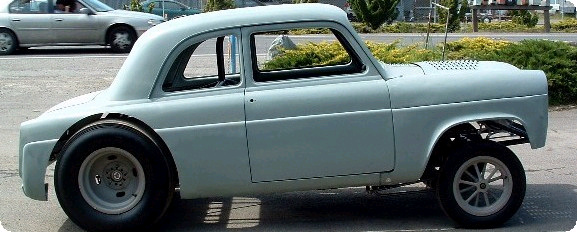
The Gosson Bros. BTU Anglia's progression through the West Coast Gas classes continued last week at Sacramento Raceway. This initial mock-up shot predates the installation of an alky injected 377" Chevy, later swapped for a carbureted 355-incher by 2nd owner Rick Smith, who teamed with 4-time VRA Champion Craig Wallace to perform several sheetmetal changes. Smith raced it successfully before selling to Rich Feichner, who has incrementally stepped his program up to final round status. (Scotty shot)

The BTU scorching the tarmac at Sacto. The obese Willys never had a chance against the flyweight Anglia. Feichner dominated this C/Gas final round to the stripe, where he lost on a breakout. The BTU is too fast for its own good. And I'm a proud uncle. (Photo courtesy One pic at a time)

                                                                                   *


SQUIRREL AND TOOLBOX

This week's random squirrel file pick is titled "Edgar the Squirrel". Not sure Edgar's even a real squirrel, but the shot was contributed by a trusted photojournalist, so will give it a free pass. (Photo courtesy Chris Shelton)

Credit where it's due: Yes, we have amassed a squadron of dedicated squirrel photo acquisition specialists (AKA "Interns") who scour the web 24/7 for your amusement. This squirrel wrangler's SGE ID badge photo was cropped for good reason... (Photo courtesy SGE Human Resources Department)

... as it seems several of our renowned award-winning squirrel photos have vanished and been replaced with images such as this. Hence, the dissolution of the renowned award-winning SGE internship program. (Photo courtesy anonymous ex-SGE award-winning intern)

Though they didn't fulfill it, at least the Squirrel Department interns understood their assignment (kinda). Things were even worse in the SGE Toolbox Division. Our sincere apologies to the readership for this disturbing development. We hereby publicly vow to have the problem corrected by next week's post. (Photo courtesy anonymous ex-SGE award-winning intern)


GRIN


As a complement to last week's spamming of Lost Drag Strips II, East Coast correspondent Motormouth Ray contributed these snaps of the book posing with a length of New York National Speedway's iconic yellow guardrail. Just how did Ray come to be in possession of this crusty artifact (the guardrail, not the book)? "I had gone out to John Fiore's new shop at the Eastern end of Long Island to pick up some Pontiac parts. Kilowatt Kevin and I couldn't find the shop, nor raise John on the phone, so we backed into a dirt lot facing a biker bar called The Maples, and hoped he'd drive by. Some maniac with a chop saw was making a major racket, but when it stopped, my phone was ringing. It was John, telling me to look behind me. Yep, we got lost, not five feet from his shop. Turns out, it was John doing all the cutting: Sections of the National Speedway guardrail that were still standing, even after all the urban development of the property. Generous John then offered Kevin and I our own pieces of history, which we graciously accepted. That's the mystery, unraveled."  (Photo courtesy Motormouth Ray)

Bonus National Speedway shot: "Here's my #1 prize, which was bestowed on my 'one that got away' - the '71 bigblock Camaro that I once owned and raced. And now... you know... the rest... of the story... Good day." (Photos courtesy Motormouth Ray)


While we're in the spam zone, here's our first album, intended as the soundtrack to an as-yet still unpublished book detailing my 2009 cross-country hitch hiking odyssey to various U.S. race tracks. The album is still available at Amazon.com and Createspace.com. (Image courtesy Gosson Bros. Racing Library)

                                                                                    *